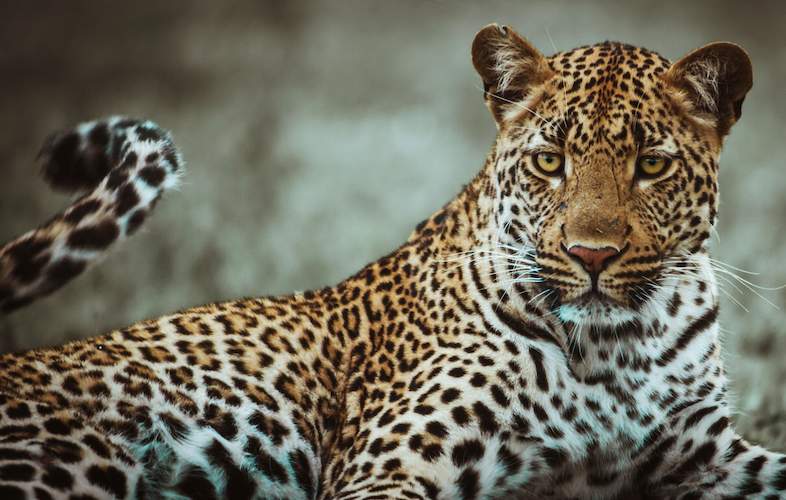
Fascinating Feline Journey: Leopard in Untamed Savanna
Introducing our fascinating feline journey into the realm of one of nature’s most enigmatic predators – the Leopard (Panthera pardus).
Imagine stepping off a bustling city bus onto an untamed African savanna. You’re greeted by golden grasses stretching as far as you can see, punctuated every few miles with towering acacia trees and clusters of vibrant wildflowers that catch your eye like dazzling jewels against dark green backdrops.
Then, suddenly from the edge of what appears to be a vast open plain materializes one of nature’s most striking creatures - the Leopard. Its lean body is draped in pale yellowish fur overlaid by spots resembling speckled brown ink on parchment paper. As this elusive feline peers at you with piercing green eyes from its hidden vantage point atop an acacia, your heart pounds harder than usual; it's thrilling yet humbling to be so close to a creature that has reigned supreme in the wild for thousands of years.
Now, ask yourself why we should care about leopard. Whether on camera as part of wildlife documentaries or simply by viewing these magnificent predators in books and scientific literature, leopards capture our imaginations with their agility, grace under pressure, and evolutionary adaption to a diverse range of environments across Africa and Asia. Their status as one of the five extant cat species within the genus Panthera is no minor detail – it speaks volumes about how remarkable these animals really are.
In this article, we’ll delve into various aspects that make leopard fascinating - from their unique physical characteristics such as those mesmerizing spots covering much of their body to their social dynamics and natural behavior. We will also explore some lesser-known facts in the animal kingdom regarding leopards – like why they're so adept at climbing trees, or even how humans have used them for various pursuits throughout history.
So sit back, relax into this journey through leopard-land, where every twist of nature's tapestry holds a story waiting to be told. Let us uncover what makes these majestic cats truly stand out in the animal kingdom and why they remain an invaluable part of our planet’s ecosystem today.
The Full Story of Leopard Evolution and Physical Characteristics
The story of the leopard (Panthera pardus) is one that spans continents and millennia – from its initial evolution in Africa during the Early Pleistocene to becoming an enduring symbol across Asia as well. This magnificent feline has captivated humans for centuries with tales of stealth, agility, and beauty.
Physically, leopards are strikingly distinctive creatures known by their pale yellowish or dark golden fur covered in dark spots grouped into rosettes that resemble ink splatters on parchment paper. Their bodies boast a lean yet muscular build reaching lengths from 92 to 183 cm (36–72 inches), with tails measuring between 66 and 102 cm (26-40 inches) in length and shoulder heights ranging between 60 to 70 cm (24-28 inches).
Male leopards typically weigh from 30.9 kg (68 lbs) up to a heftier 72 kg (159 lbs), while females are smaller with weights falling within the range of 20.5 kg (45 lbs) and reaching as much as 43 kg (95 lbs). Their distinctive spotted coat is not only aesthetically pleasing but also serves an important function – providing effective camouflage against a variety of backgrounds, from dark forest canopies to light sandy plains.
Key Developments in Leopard Evolution
Leopards have been around for quite some time now. The first description was given by Carl Linnaeus as part of his comprehensive work "Systema Naturae" back in 1758 (Linnaeus, 1964). Over the years since then, several subspecies were proposed – primarily due to geographic variations seen across their vast range.
The most notable evolutionary milestones for leopards include the initial migration into Eurasia during the Early-Middle Pleistocene transition. This was followed by a period of dispersal and adaptation in both Africa and Asia where they continue to thrive today (O'Brien et al., 1978).
Multiple Perspectives: Expert Opinions on Leopard
Understanding leopards involves more than just observing them from afar; it requires the insights provided by experts who study these animals closely. One such expert, Dr. Sarah O’Brien of San Diego Zoo Wildlife Alliance, emphasizes how crucial understanding leopard ecology and behavior is for conservation efforts.
"Leopards are incredibly adaptable," says Dr. O'Brien in an interview with BBC Nature (O'Brien as cited in Alstrom & Kitchener, 2016). "They can thrive in various terrains from grasslands to forests – this adaptability makes them more resilient against threats like habitat loss and poaching."
Other researchers focus on different aspects of leopard life. Dr. Jane Goodall has shared her experiences observing wild leopards at the Gombe Stream Research Centre, noting their role as apex predators in savanna ecosystems (Goodall & Leakey 1970).
Broader Context: Leopard’s Place Within Ecosystems
Leopard's impact extends far beyond individual animals; they play vital roles within broader ecological systems. As top-level carnivores with diverse diets that include everything from small mammals to birds and reptiles, leopards help control prey populations – preventing overgrazing of vegetation in their habitats (Lindsey et al., 2014).
For instance, a study conducted by Lindsey & colleagues found that leopard presence significantly impacted gazelle population dynamics on the continent. Without natural predators like these big cats to keep numbers under check, herd sizes could grow unchecked and lead to overgrazing of local vegetation.
Real-World Impact: Effects on People
While leopards primarily interact with people indirectly through their ecological roles described earlier, they do occasionally cross paths in more direct ways. For instance, encounters between humans and wild leopards can occur when these animals venture into human-populated areas looking for food or territory – often taking advantage of abundant livestock as a source.
On the other hand, some interactions highlight how valuable leopard conservation efforts are to local communities who might profit economically from ecotourism opportunities related to sightings (Khan & Gopalasamy 2016).
In conclusion, leopards' evolution through time has shaped them into adaptable and versatile hunters. Their unique physical traits continue to intrigue researchers while their ecological importance means they remain key players within complex ecosystems globally.
We can look forward to continued studies exploring how these magnificent animals might be affected by climate change or other emerging challenges in the coming years, ensuring that we not only learn more about leopards but also protect them for future generations.
Summary
In this exploration of the remarkable Leopard (Panthera pardus), we've delved into its evolutionary journey spanning continents over millennia – from Africa to Asia, leopards have captivated humans with their stealthy prowess and striking beauty.
Understanding these cats requires more than just studying physical characteristics; it involves appreciating their ecological importance. Leopards are apex predators that help maintain balance in ecosystems by regulating prey populations. Whether they're treading the scorching sands of Africa or prowling dense forests, leopards demonstrate remarkable adaptability – a key trait driving successful conservation efforts.
As our world faces new challenges like climate change and habitat disruption, understanding how leopard species fare will be crucial for future generations to safeguard these incredible animals. We should continue monitoring their population dynamics in various regions while supporting initiatives aimed at preserving critical habitats.
Ultimately, leopards stand as living testaments of evolution's wonders – creatures that have weathered centuries yet remain resilient against threats. As we move forward into an uncertain future, let us remember the lessons learned from these majestic animals and strive to ensure they continue thriving in our world for years to come.
So next time you catch a glimpse of one leaping gracefully across its landscape or witness humans successfully coexisting with this iconic species – take a moment to recognize the significance not just of each individual leopard, but all their contributions shaping complex ecosystems. What other secrets do these masters of stealth and agility yet hold?