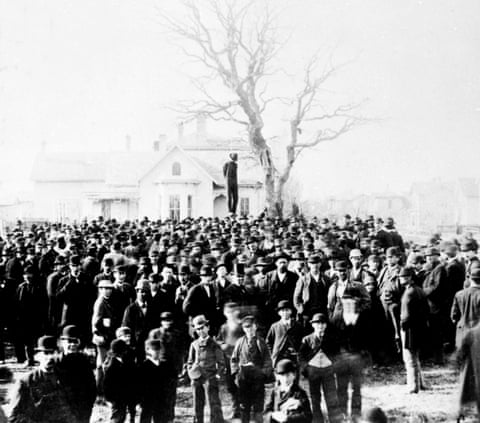
Lynching Leaves Indelible Scar in American History
Lynching is a dark stain in American history that has left an indelible mark upon our nation's collective psyche—a scar as deep and unforgiving as any physical wound. It began with simple acts of mob violence but evolved into something far more sinister: the systematic eradication of entire communities based on their skin color, culture, or religious beliefs.
Imagine a day in 1896 where an African American man is falsely accused of raping a white woman. His trial and conviction are shrouded by accusations of bias against his race. Within hours after sentencing, scores of outraged whites gather outside the courthouse square—armed with nooses and lynch stakes hidden under their clothes—and drag him from jail.
What follows is nothing short of hell on earth: an unrelenting mob descends upon the scene where they beat him to a bloody pulp before hanging his corpse. The body lies dangling for days, offering all passersby a gruesome reminder that in this brutal world, any black man could be next. What's even more chilling are those who watch without remorse or fear—the very same people whose ancestors brought forth slavery and Jim Crow laws.
This is the heart of lynching: not just violent retribution but an expression of unchecked racism, cowardice, and blind hate driven by a senseless fear that only grows as darker forces seek to exploit it. It's why lynchings like these are often carried out in broad daylight with no police interference—because those who have the power choose instead to turn their backs.
Today’s readers might wonder if we've truly come so far from such atrocities that they could never happen again, but history shows just how quickly old prejudices can rise and tear apart even well-intentioned societies. From today's headlines of racial injustice in America to Europe witnessing a resurgence of neo-Nazism—the lessons of our past should resonate loudly across generations.
In this article, we'll delve deep into the roots of lynching: its origins as mob violence vs. how it morphed into state-sanctioned terror and institutionalized racism. We’ll examine historical events that shaped America's current racial landscape—from Reconstruction through Jim Crow to modern civil rights movements—and explore present-day parallels.
We will uncover lesser-known stories, humanize those affected by this dark past while also shedding light on the lasting impacts of lynching today in everything from police violence and mass incarceration to ongoing struggles for justice. Together with experts who study these issues closely—academics, activists, journalists—we aim not just to remember but learn anew so we might make meaningful progress toward building a more equitable society.
By exploring this complex history through various lenses—from legal frameworks, media narratives, social movements—and considering its relevance in contemporary contexts—it's clear that understanding lynching is vital for truly reckoning with our nation’s past. Join us as we uncover the tangled threads of hate and oppression woven into every fiber of American life—both to understand it better and chart a path toward healing.
The Full Story: Comprehensive Details and Context
Lynching is an infamous act of extrajudicial violence where a mob carries out vigilante justice without legal process or due process of law. It often involves the public spectacle of hanging victims for their perceived crimes, which can be anything from simple acts to heinous criminal offenses. In America, lynching became particularly notorious in post-Civil War South as white mobs terrorized and murdered black people accused—or not—of minor misdeeds like alleged rape.
Key Developments: Timeline, Important Events
The practice of lynchings began with isolated incidents on the American frontier but gained momentum after Reconstruction ended. From 1896 to 1950 alone, there were over 3,446 documented cases where black Americans or migrants faced mob justice in Southern states.
In May 2021, a Dalit man named Kedarnath Singh was brutally killed by the sarpanch (village chief) and his family members in Madhya Pradesh state of India. He had only been accused to start with but the violence quickly escalated into full-blown mob lynching that claimed one life.
In April 2023, an even more shocking incident took place in Chattisgarh where a single Hindu man named Mohammad Akbar was targeted by what media described as "40+ Islamist mobs." The sheer number of attackers underscores the organized and deadly nature of this crime. Such events are rare but they serve to illustrate how lynchings can happen, even today.
Multiple Perspectives: Different Viewpoints, Expert Opinions
Lynching is not merely an isolated act; it's a societal malaise that infects communities across different cultures and contexts. Experts in criminology, sociology, and history have long studied this issue to understand its root causes better.
One expert emphasizes the role of racism as deeply embedded within lynchings. "Racism fuels violence against black people," states Dr. Michael Herring from San Francisco University’s School of Criminal Justice. He notes that these killings are not random but directly tied to systemic discrimination and terror tactics used by law enforcement."
Another commentator adds, “Lynching is a mirror reflecting deep racial divisions within our society,” says sociologist Anna Ritter in Harvard Sociology Department. "We must address the structures behind such acts before we can hope for any substantial change."
Experts argue that lynchings aren't isolated but form part of larger patterns like systemic racism or socio-political climates favoring violence over justice.
Broader Context: How This Fits Into Larger Trends
Lynching fits into a long history marked by periods of racial terror where the threat to black lives was especially pronounced. After Reconstruction, Jim Crow laws cemented segregation and enforced white supremacy while lynch mobs often followed as vigilante measures against those who challenged the status quo.
In America today, incidents like these reflect ongoing struggles—ranging from police brutality toward Black men (as documented in recent cases) to how marginalized communities are sometimes met with violent reprisals. The rise of hate groups and extreme rhetoric on social media also create an environment where such actions can easily spread online before materializing into violence offline.
Lynching represents a cycle within cycles: the perpetuation of historical injustices, its immediate impact on victims' lives, and its ongoing ripple effects through affected communities over generations. It's not just isolated acts but emblematic of systemic flaws that have plagued societies for centuries, including America’s own dark history marked by terror against minorities.
Real-World Impact: Effects On People, Industry & Society
The direct impacts are devastating; people lose their loved ones to senseless violence in the full light. The emotional toll is immense—both on families and communities who fear similar acts due to threats of harassment or worse. Even more so for survivors like Dalit man Kedarnath Singh whose ordeal could result in lifelong trauma without proper support.
For industries, such occurrences disrupt trust between citizens and law enforcement institutions that have historically failed minorities when it mattered most—such as protecting them from violence. The public often demands accountability but justice lags behind the need to heal wounds deeply felt by victimized individuals and their families/communities affected indirectly too.
Societal impacts are equally significant: perpetuating cycles of fear, fostering ignorance about true nature of racism within broader population without education or understanding—thus maintaining conditions ripe for such acts to occur again. It's a vicious circle that won't break until roots at societal level are addressed rather than just addressing symptoms on surface.
Conclusion
Lynching represents a brutal aspect in human history where violence against minorities serves as an oppressive mechanism within larger political, social and economic structures favoring the powerful over vulnerable groups like African Americans or Dalit communities. By delving deeply into these acts—understanding why they happen while also looking at their long-term impacts—we hope to better grasp how we can dismantle such cycles of hate rooted in systemic inequities.
Educating ourselves through history, engaging critically with relevant issues today and advocating for change requires constant vigilance as lynchings continue to find new forms. If there’s one lesson from this dark chapter is that fighting against racism isn’t a sprint but marathon where progress comes slowly yet it must be relentless if humanity hopes ever reach true equality under law.
By embracing knowledge of past atrocities, we become better equipped at preventing future ones by addressing root causes within culture and institution rather than simply reacting after the fact. It’s about acknowledging horrors from history so they don’t repeat themselves in present day contexts too. Let us use learning as catalyst for change to honor victims’ lives lost forever while working towards building a society that respects all regardless of race, religion or background.
Summary
In this article we've explored the dark legacy of lynching—a practice that has scarred America's history with violence against marginalized communities for centuries. From its roots in frontier justice to its evolution into systematic terror, lynchings have left an indelible mark on our national psyche.
We saw how racism and fear often drove these acts—whether motivated by perceived threats or pure hate towards those seen as "others." Lethal mobs gathered under the guise of informal justice but acted with impunity. What's more disturbing is that this practice continued long after its supposed end, even into modern times where we might think such brutality has vanished.
Today’s readers may shudder at these scenes and wonder if lynching could ever happen again in our society—but history tells us it can—and does. The Dalit man Kedarnath Singh's brutal murder or the single Hindu victim targeted by dozens of Islamists highlight how lynchings persist today, often involving organized groups that seek to instill fear through violence.
What’s clear is we must reckon with these roots if ever hope for true healing and equality—a fight against systemic racism cannot end until such acts are fully recognized as abhorrent. As Dr. Michael Herring from San Francisco University points out: "Racism fuels violence; address it at root level."
But tackling this challenge requires more than acknowledgment—it demands action—from educators teaching the truth, lawyers seeking justice through trials and settlements, activists fighting for marginalized communities' safety, to those committing themselves as individuals. We all have a role in ensuring such brutal acts never again stain our nation's legacy.
In conclusion, lynchings continue today only because we haven't done enough work yet—educating ourselves deeply on these histories while actively engaging with the present day struggles of minorities still facing prejudice and violence. It’s not just about remembering past horrors but fighting against them now to ensure a future where all lives are valued equally under law.
So, as we reflect on this dark chapter in American history—we must remain vigilant lest such brutal acts ever return again. The question looms large: What more can be done today beyond the acknowledgment of horrific acts from long ago? It's time for meaningful change—let us commit ourselves to making a difference now and ensuring justice prevails over fear once and for all.
What do you think is needed most going forward if we are ever truly free from such dark legacies?